

Infrared Technology
Passive-Infrared
Far Infrared and Sensing
Value of Far-Infrared Sensors
- Non-Contact, Instantaneous Temperature Detection
-
Detects temperature and presence without touching the target
- Detection Even in Dark Environments
-
No light source required, making it effective at night and in dark environments
- Passive and Low Power
-
No need to emit anything
Optex’s Unique Strengths and Applications
Automatic Door Sensors
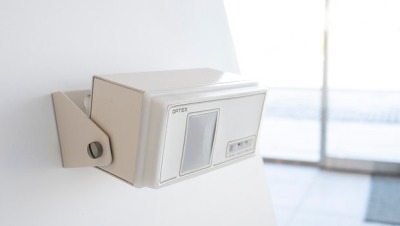
Optex transformed the global standard from pressure-sensitive floor mats to“non-contact”detection. Near infrared is now the predominant technology, but far-infrared sensors are still actively used in areas with heavy snowfall and other demanding environments.Outdoor Security Sensors
Although far infrared is susceptible to environmental changes, Optex achieves high reliability and suppresses false alarms through optical technology × field data × algorithms. Another strength is its product lineup designed to meet the climates and regulations of countries around the world.Expert Interview
-

Shun Onishi
DepartmentSecurity Business Div. Engineering & Development Dept.
The Key to Outdoor Sensing Using Far Infrared
Far-infrared sensors are simple sensors that detect temperature differences. For that very reason, what matters most is not the sensor itself, but the design that determines what to detect and what not to detect. Because various factors affect detection in outdoor environments, we have continuously incorporated knowledge gained from sites and customers around the world into our product development. “Reliably detect what should be detected, and do not respond to anything else.” The accumulation of technologies developed to achieve this is the strength of Optex’s sensing technology. Customers around the world value not only the performance of our products, but also their reliability for safe, long-term use.
OTHER
TECHNOLOGIES
-
Active-Infrared
Near infrared is an active sensing technology that uses LED illumination to detect changes in reflected or blocked light.This technology allows for precise detection area control and is widely used for stable detection in applications such as automatic doors, active infrared (AIR) security systems, and water quality measurement.
-
Infrared Laser
LiDAR is an optical ranging technology that uses laser time-of-flight (ToF) measurement to determine the distance to and shape of a target with high accuracy.It is applied to precision spatial sensing in applications such as outdoor intrusion detection and critical facility monitoring, including REDSCAN.
-
Doppler Radar (Microwave)
This radar technology detects moving objects using reflected radio waves and the Doppler effect. It is relatively unaffected by rain, fog, snow, or lighting conditions and is used for outdoor applications such as vehicle detection, parking lots, and gate operation.
-
FMCW Radar (Microwave/Millimeter Wave)
FMCW is a radar ranging method that analyzes the distance to and speed of a target from the beat frequency between a frequency-modulated continuous wave and its reflected wave.
-
MIMO Radar (Microwave/Millimeter Wave)
MIMO radar uses multiple transmitting and receiving antennas to form a virtual array, improving angular resolution and direction estimation. Highly resistant to adverse weather and darkness, it can be used for long-range detection in applications such as outdoor security, vehicle detection, and critical facility monitoring.
-
Water Quality and Hygiene Applications
Optical water quality sensors use multiple wavelengths of light, including near-infrared, infrared, and UV, to detect changes in turbidity, color, scattering, and absorbance. They can be used for water quality management, including continuous monitoring of drinking water, wastewater, and industrial effluent.
-
Image Recognition Technology
This sensing technology uses camera images to perform tasks such as object detection and classification, pose estimation, and people tracking. It is used for security, people counting, access control, and other applications, providing advanced situational awareness by detecting the movements of people and objects.
-
Vibration Detection Technology
Vibration detection sensors measure vibration to detect intrusion, impacts, and equipment abnormalities. Optex uses this technology to improve the reliability of outdoor security and equipment monitoring.